Full edition
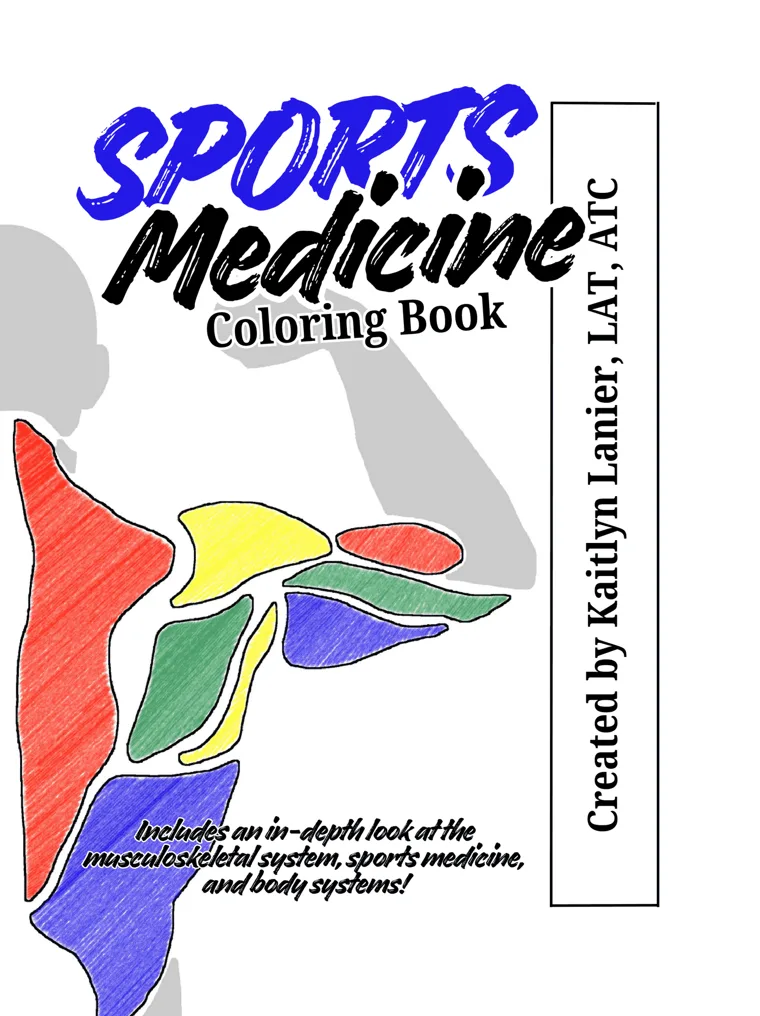
Sports Medicine Coloring Book
A full anatomy course you work through with a pencil in your hand. Every plate is unlabeled line art with numbered leader lines, so you are recalling structures rather than rereading them — and every spread closes with a clinical note tying the anatomy back to sport.
- Five parts, from anatomical position through the nervous system
- Over 60 labeled plates with numbered leader lines
- Six common sports injuries broken down by mechanism
- Wrist, thumb spica, and ankle taping walkthroughs
- Extent
- 128 pages
- Format
- Paperback, 8.5 × 11 in
- Written for
- Athletic training students, kinesiology and allied-health majors, coaches, and anyone heading toward the BOC exam.
128
Pages
5
Parts
60+
Labeled plates
3
Taping walkthroughs
Take a peek inside
Fourteen pages from the print file.
Unlabeled line art with numbered leader lines, and a clinical note at the bottom of each plate tying the structure back to sport. Tap any page to read it full size.
Table of contents
Everything in the book, as printed.
Transcribed from the book's own contents page, so what you see here is exactly what arrives.
Introduction to the Musculoskeletal System
The vocabulary of movement — planes, directions, and every joint motion named the way a clinician names it.
Anatomical Position8
Anatomical Planes9
Anatomical Motions
- Head & Neck10
- Trunk11
- Shoulder & Scapula12
- Elbow & Forearm14
- Wrist & Hand15
- Hip & Knee16
- Foot & Ankle17
Anatomical Directions19
The Skeletal System
From bone tissue up to the whole frame, then the joints and ligaments that decide how far a body can go.
Bone Tissue26
Gross Skeletal Anatomy
- Anterior Skeleton28
- Posterior Skeleton30
Axial & Appendicular Skeleton32
The Vertebral Column34
The Skull
- Cranial Bones36
- Facial Bones38
Bones of the Upper Thorax40
Bones of the Hand42
Bones of the Pelvic Girdle44
Bones of the Lower Leg
- Bones of the Foot46
- Bones of the Foot & Ankle48
Joints of the Body
- Types of Joints50
- Joints of the Shoulder52
- Joints of the Wrist & Hand54
- Joints of the Pelvic Girdle56
- The Knee Joint58
- Joints of the Foot & Ankle60
Ligaments
- Shoulder Ligaments62
- Elbow Ligaments64
- Knee Ligaments66
- Ankle Ligaments68
The Muscular System
Muscle tissue, then every major group an athlete trains — head to hip, front and back.
Skeletal Muscle Tissue72
Gross Muscular Anatomy
- Anterior Musculature74
- Posterior Musculature76
Muscles of the Head & Neck
- Facial Muscles78
- Lateral Neck Muscles80
Upper Extremity Musculature
- Upper Body Musculature82
- Muscles of the Back84
- The Rotator Cuff of the Shoulder86
- Anterior Forearm Musculature88
- Posterior Forearm Musculature90
Lower Extremity Musculature
- Anterior Hip Musculature92
- Posterior Hip Musculature94
Sports Medicine
Injury mechanisms drawn out structure by structure, and three taping jobs explained step by step.
Tendons vs. Ligaments98
Muscle Strains99
Ligament Sprains100
Types of Fractures101
Common Sports Injuries
- Hamstring Strain102
- Quadriceps Strain103
- Achilles Rupture104
- Lateral Ankle Sprain105
- ACL Tear106
- Jones Fracture107
Taping Techniques for Injuries
- Wrist Tape Job108
- Thumb Spica Tape Job109
- Ankle Tape Job110
Body Systems
The systems that decide how long an athlete lasts: breathing, circulation, and the wiring in between.
The Respiratory System112
The Cardiovascular System & The Heart114
The Nervous System
- The Brain118
- The Neuron120
- The Brachial Plexus122
- Dermatomes124
- Myotomes128
Also available
Sports Medicine Coloring Book — Student Edition
The same anatomy, simplified for middle and high school: fewer structures per page, plainer language, classroom-ready pacing.